
From Elo to MMR: how ranked ladders really rate you
Every ranked mode in a sports game is, underneath, a descendant of a system built for chess in the 1950s. Division Rivals in EA SPORTS FC, the competitive playlists in Rocket League and the medals in Dota 2 look nothing alike on screen, but after every match they ask the same question: given who you were expected to beat, how surprised should we be by the result?
Where it starts: Elo
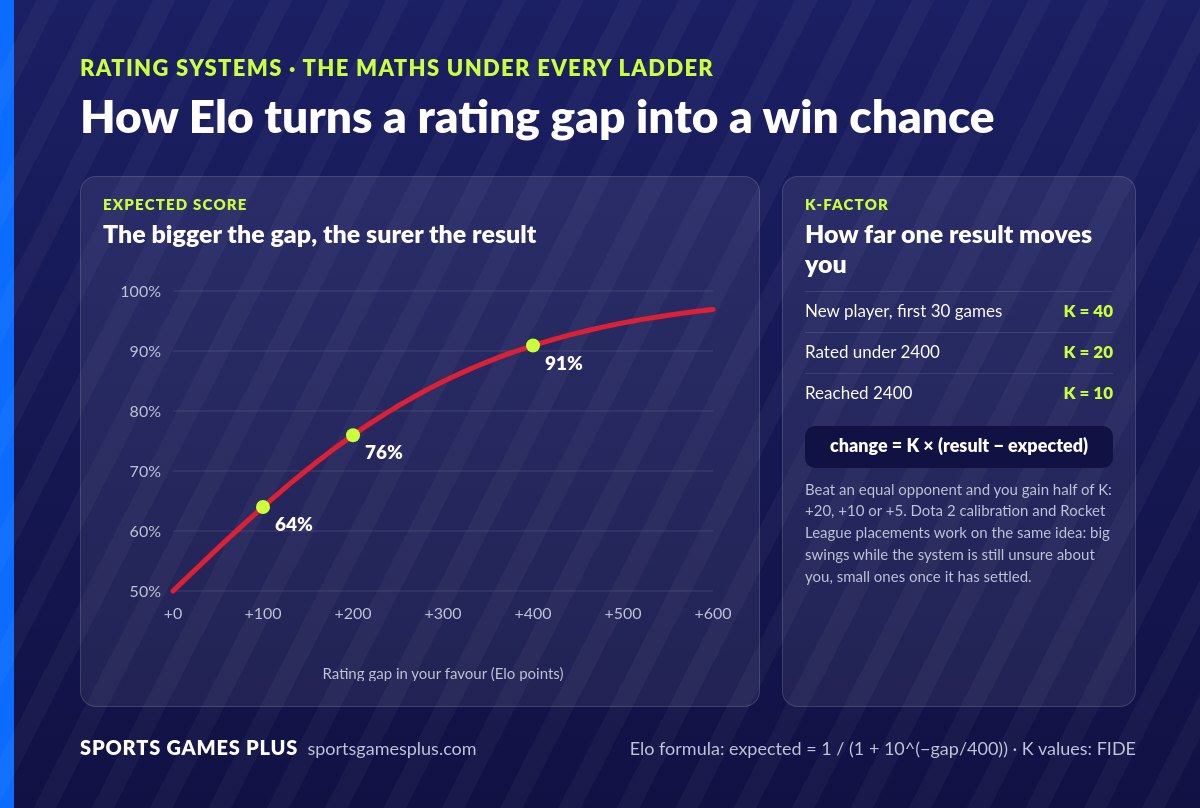
Arpad Elo, a Hungarian-American physics professor and chess master, designed his rating system for the United States Chess Federation, which adopted it in 1960. FIDE followed in 1970. Its core is one formula: the gap between two ratings gives an expected score. Equal players are expected to split the points, a 200-point favourite should score about 76%, a 400-point favourite about 91%.
After the game your rating moves by the difference between what happened and what was expected, multiplied by a constant called K. FIDE uses K = 40 for new players, 20 for most rated players and 10 once you reach 2400. Beat an equal opponent at K = 20 and you gain 10 points. Beat someone 400 points weaker and you gain less than 2, because the system saw it coming.
Two ideas from that are worth keeping for any game. Upsets pay more than expected wins. And new ratings move fast on purpose, because the system knows little about you yet.
What sports games and esports changed
Elo was made for one-on-one games. Team games needed more. Mark Glickman’s Glicko system added a measure of how certain a rating is, and Microsoft’s TrueSkill, written for Xbox Live, carried the idea over to teams of players who come and go. Modern matchmaking ratings are cousins of both: a number for your skill, a number for how sure the game is about it, and an update after every match.
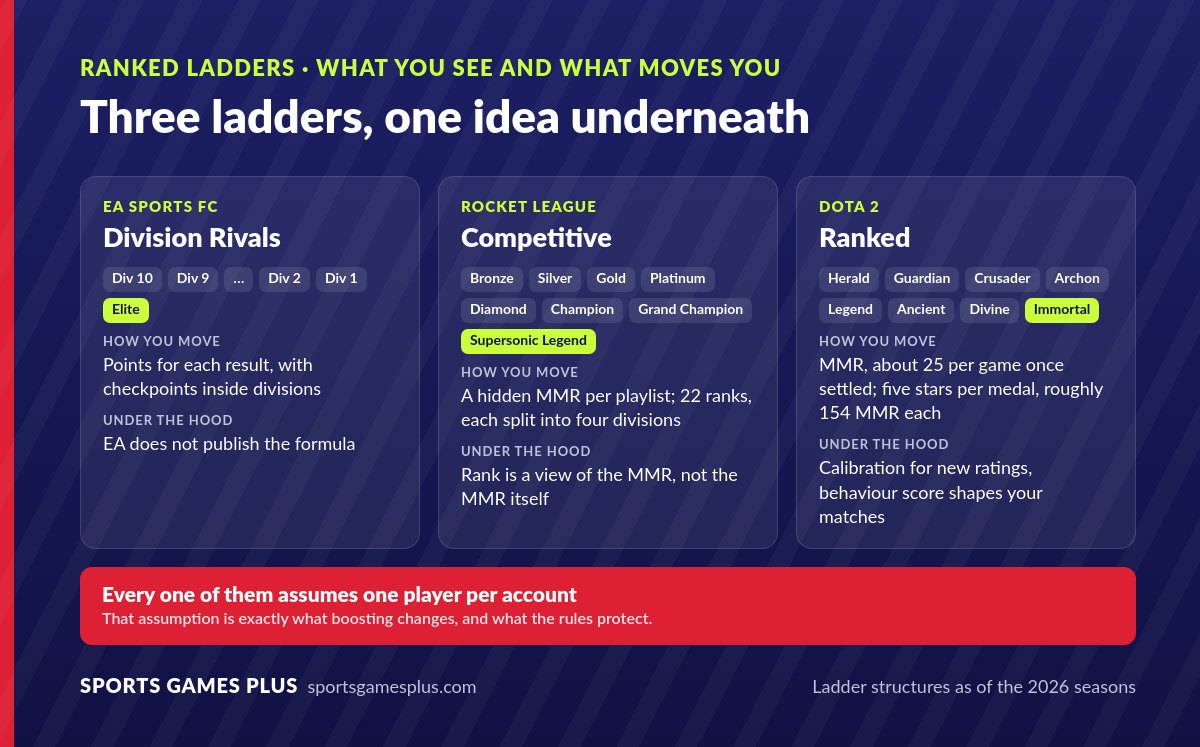
On top of that, the games put a friendlier ladder. Division Rivals in EA SPORTS FC shows divisions from 10 up to Elite and moves you with points, with checkpoints inside divisions so one bad night does not undo a good week; EA does not publish what sits underneath. Rocket League keeps a hidden MMR for each playlist and shows it as 22 ranks from Bronze I to Supersonic Legend, most of them split into four divisions. That is why a rank can sit still while the number under it moves, and why you can be Diamond in 2v2 and Platinum in 3v3. If you are still learning the car itself, our Rocket League basics guide comes before any of this.
Dota 2 is the most open about its number. Players quote their MMR outright, roughly 25 points change hands per game once a rating has settled, and the medals are a translation of that number: seven medals from Herald to Divine with five stars each, about 154 MMR per star, then Immortal. Fresh ratings go through calibration, which is Dota’s version of K = 40, and a behaviour score shapes who you are matched with.
Where boosting comes in
All of these systems assume one person per account. A boosting service changes that, and how it changes it decides how risky it is.
Account boosting, where a stronger player logs in and plays for you, is the fastest route and the one the rules forbid. Steam’s subscriber agreement does not allow you to share your login, and a rating earned by somebody else tends to slide back once you start playing at it yourself.
Duo boosting keeps the login with you. You queue in a party with a high-MMR player on your own account, so every game is still yours and the matchmaker rates you as a party. It is slower, but nobody else touches the account, and you get to watch a better player make decisions up close.
Coaching leaves the ladder alone: replay reviews and live sessions aimed at the habits that keep your rating where it is.
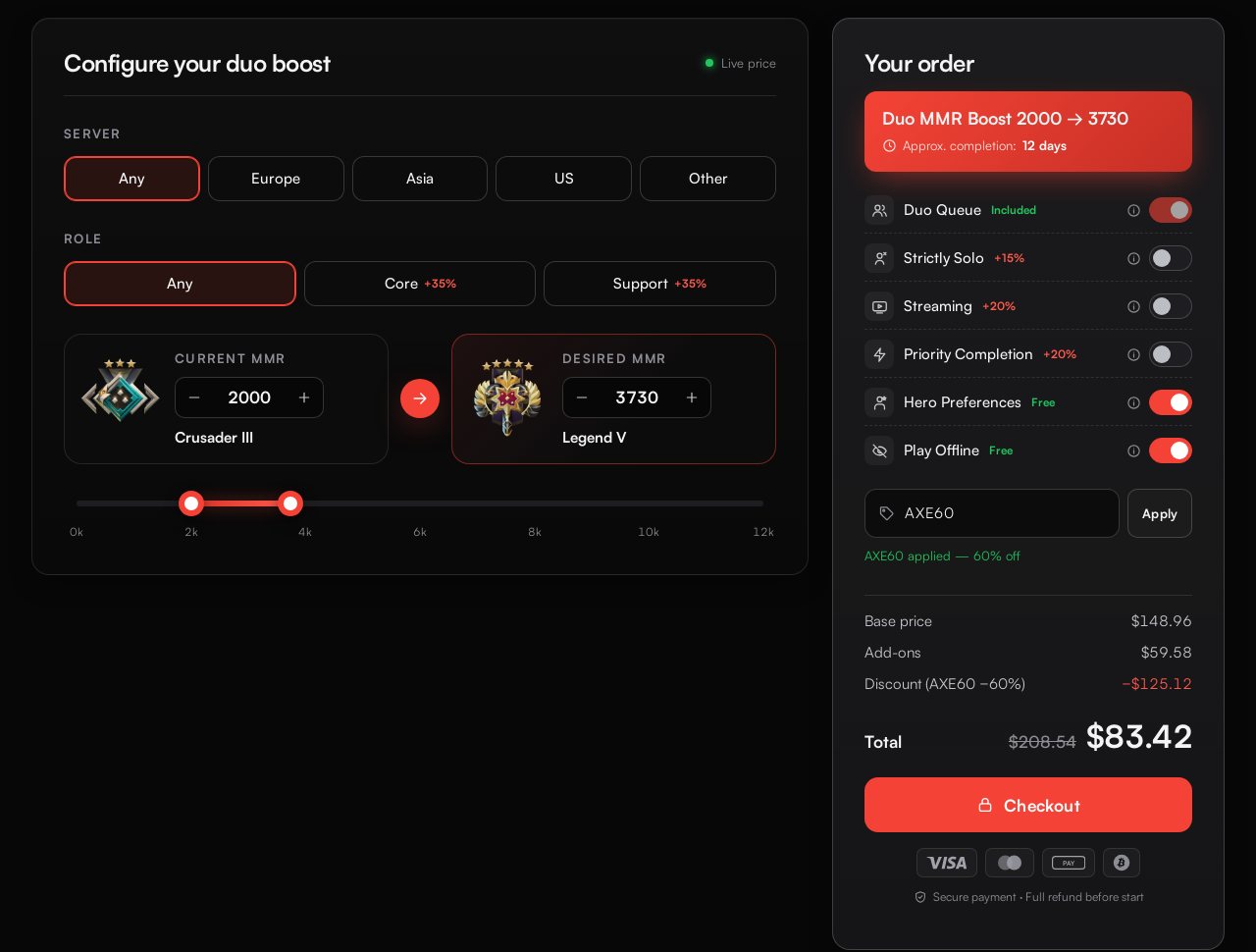
For Dota 2, Dota2Boosting offers all three. Its duo MMR boost pairs you with a booster on your own account and lets you choose the server and your role, and the site says every booster is verified at 7,000 MMR or more. The order form also translates MMR into the medal you will see in game, a handy check on what a target means: 2,000 MMR is Crusader III, 3,730 is Legend V.
The short version
Your rank is a view of a number, and that number moves by how surprising each result is. Win the games you are expected to lose and you climb fastest; lose the ones you should win and you pay the most. If you do pay for help, duo games and coaching keep the account in your hands, and leave you with a rating you can actually hold.
Tags: multiplayer, ranked

Writes about Rocket League, skateboarding and extreme sports games for Sports Games Plus.
Join the discussion