
FUT packs vs CS2 cases: what the odds screen actually tells you
Every Ultimate Team player has opened a pack and felt robbed. Every Counter-Strike player has watched a case roll past a knife and stop on a blue skin. The two games sell the same thing, a sealed box with a random prize, and both publish odds. Read side by side, though, those odds tell you very different amounts.
Three ways to publish odds
There are really only three formats, and what separates them is how much detail survives.
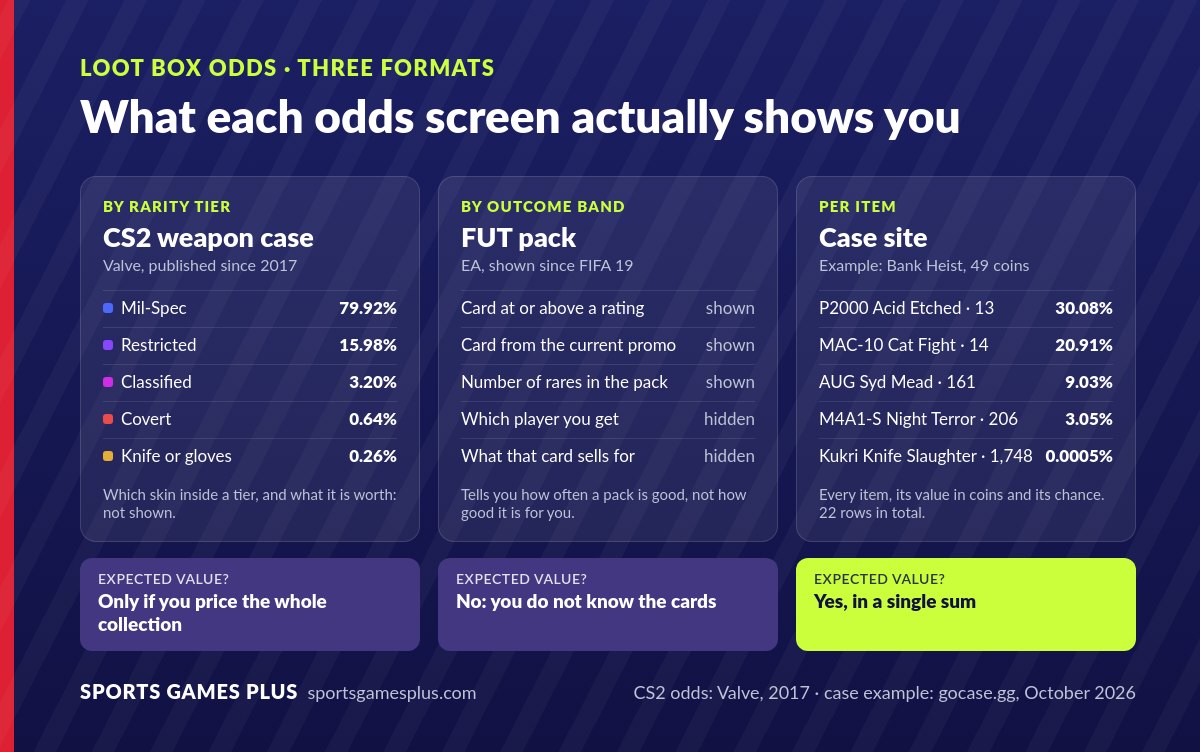
By rarity tier. This is what Valve does for CS2 weapon cases, and it started doing so in 2017 because China required loot box odds to be published. A Mil-Spec skin drops in 79.92% of openings, Restricted in 15.98%, Classified in 3.2%, Covert in 0.64%, and a knife or gloves in 0.26%. Which skin inside a tier you get, and what it is worth, the client never says. The key costs $2.49 regardless.
By outcome band. EA has shown pack probabilities in Ultimate Team since FIFA 19. The screen gives the chance that a pack holds a card at or above a certain rating, or a card from the current promo. It tells you how often a pack is good, but not how good it is for you: one 86-rated card is a meta striker worth a fortune on the transfer market, another is a centre-back nobody picks.
Per item. Third-party case sites build their own cases from real CS2 skins, and the better ones list the chance of every single item next to its value. Nothing is grouped, so nothing can hide inside a group.
Why the item-level view matters
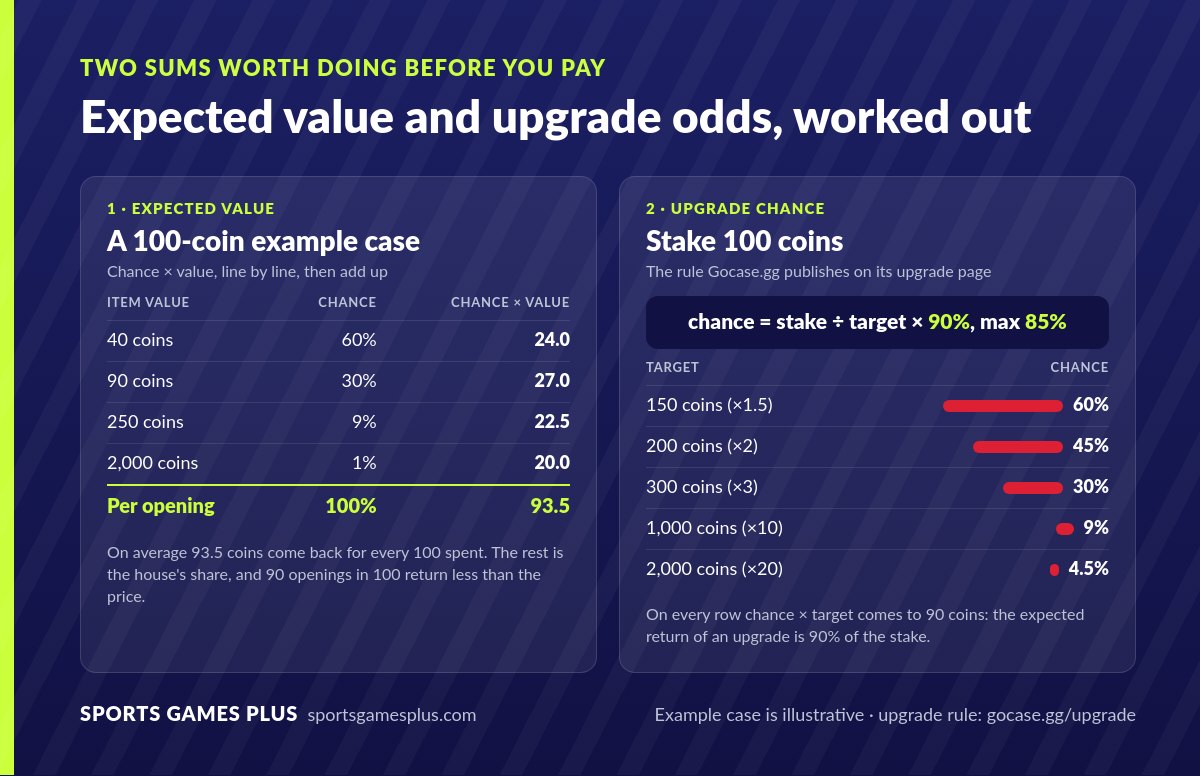
A chance on its own says little. What you actually want is the expected value of one opening: multiply each item’s chance by its value and add the lines up. With per-item odds that is a single sum. With rarity tiers you would have to price every skin in the collection first. With FUT’s bands it cannot be done at all, because you do not know which cards sit inside a band or what they sell for.
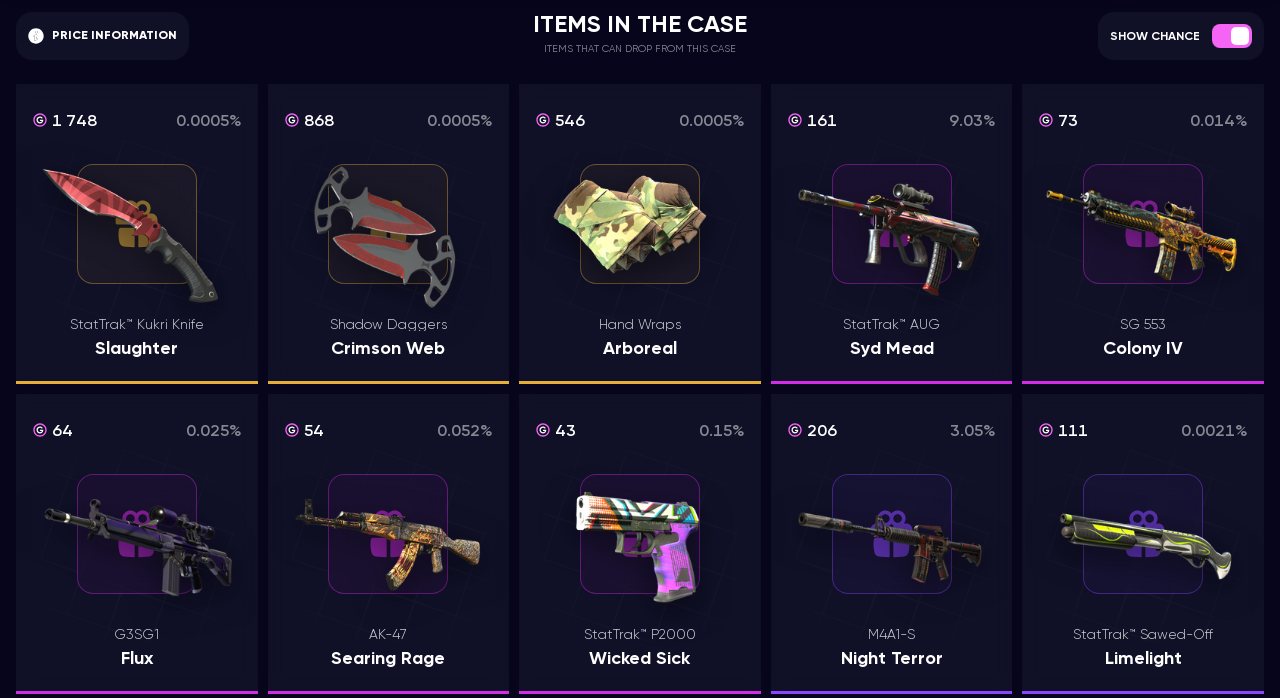
The item view also shows the shape of a case, which cover art never does. Take the Bank Heist case on Gocase.gg: it costs 49 coins, about $4.90, and holds 22 items. The three most likely drops are worth 13 to 15 coins and between them come up in roughly two openings out of three. Each of the knives and gloves on the cover has a 0.0005% chance, one in 200,000. Nobody reads a cover that way, but the table makes it impossible to miss.
Can you trust the numbers?
Published odds are a promise. To check one you need provable fairness, which neither FUT nor Valve’s cases offer and good case sites do. The scheme is short. Before you open anything, the site commits to a secret server seed by showing you its SHA-256 hash. You set a client seed of your own. Each opening feeds both seeds and a counter called a nonce through HMAC-SHA256, and the result becomes the number that picks the item. When the server seed is rotated, the old one is revealed and every opening made with it can be recomputed.
What matters is whether you can run the check yourself. Gocase.gg has a provably fair checker: paste in the revealed seed, your client seed and the nonce, choose the case, and you get the same number and the same item the server got.
Upgrades: odds you can calculate in advance
Most case sites add an upgrade, where you stake an item for a chance at a pricier one. Here the odds are a formula rather than a table. On Gocase.gg the chance is the stake’s value divided by the target’s, times 90%, capped at 85%. Stake 100 coins on a 300-coin skin and you have a 30% chance; aim at 200 and it is 45%. Multiply chance by target and you always land near 90 coins, so the house keeps about a tenth of every stake whatever multiplier you pick. Lose, and the stake is gone.
What this means for FUT players
EA has been moving the same way, slowly. Preview Packs, added in FIFA 22, show you what is inside some packs before you pay, and FC 27’s first title update shortened the reveal animations for high-rated cards, as we noted in our report on update v1.1. A FUT pack still gives you a band instead of a price list, though, and no way to verify a single opening.
So the rules are the same whichever box you open. Look for the chance of the item, not of the tier. Do the expected-value sum before you pay. Prefer a result you can verify to one you have to take on trust. And treat it as entertainment with a budget: on average a box returns less than it costs, EA stopped selling FIFA Points in Belgium back in 2019 after the regulator classed paid loot boxes as gambling, and case sites are for adults only (18+).
Tags: packs, ultimate team

Writes features and guides about sports games old and new for Sports Games Plus.
Join the discussion